Are Local Services Ads worth it for pest control companies?
For most pest control operators, yes. Local Services Ads run on a pay-per-lead model instead of pay-per-click, so you only pay when a homeowner calls or messages you directly. That structure produces 25-40% lower cost per lead than standard Google Search Ads, and the leads carry higher intent because they come from people actively choosing a Google Guaranteed provider.
The catch: LSAs reward operational discipline, not budget. If you do not answer the phone fast, collect reviews relentlessly, and follow up on every lead, the channel quietly punishes you. LSAs surface your operational weaknesses faster than any other channel because Google is watching how you handle the leads it sends.
How much do Local Services Ads cost for pest control in 2026?
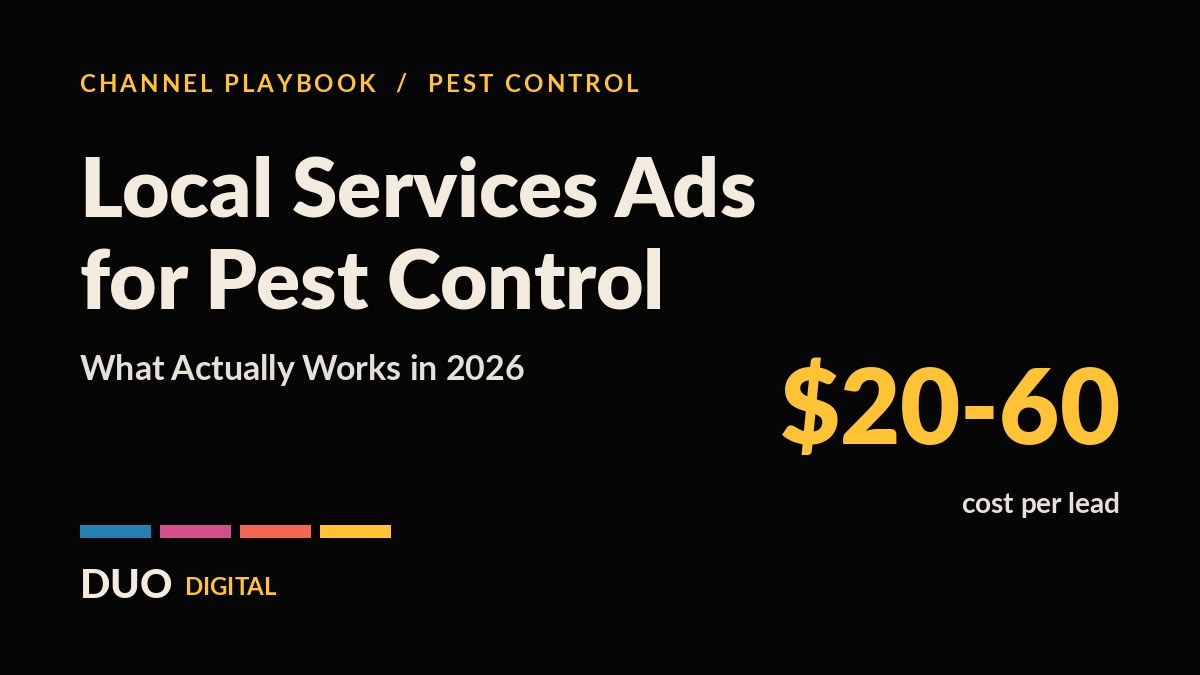
Expect $20-60 per lead in most markets, with hyper-competitive metros pushing past $70. That compares to $60-150 per lead on standard Google Search Ads. Here is how it breaks down by market:
| Market type | LSA cost per lead | Google Search Ads CPL |
|---|---|---|
| Low-competition (rural, suburban) | $20-35 | $60-90 |
| Medium-competition (mid-size cities) | $35-60 | $90-130 |
| High-competition (major metros) | $60-70+ | $130-150+ |
The cost-per-lead number alone is misleading, though. What matters is what that lead is worth. Roughly 85% of residential pest control revenue is now recurring, and a single recurring customer is worth $1,200-3,000+ in lifetime value. A $50 lead that converts to a $45/month plan worth $1,620 over three years is not an expense. It is one of the best returns in the business. Judge LSAs on cost per acquired recurring customer, not cost per lead.
How does Google rank Local Services Ads?
Google ranks LSAs on five signals: review score, review volume, response time, booking rate, and proximity to the searcher. Your bid matters far less than operators assume. A $50 bid with a five-minute response time will beat a $75 bid with a 45-minute response.
The two signals that move the needle most:
- Reviews. A 4.8-star average is the unofficial floor for serious competition. Volume compounds with rating, so a company with 150 reviews at 4.8 stars typically outranks one with 30 reviews at 5.0. Recency counts too, which means review generation has to be a system, not a quarterly scramble.
- Response time. Google's responsiveness score is a silent kill-switch. Two weeks of missed calls can outweigh six months of five-star reviews. Operators with answer rates above 95% consistently outrank those sitting at 70-80%.
Why do most pest control companies waste money on LSAs?
Because they treat LSAs as a lead faucet instead of one stage in an acquisition system. The channel sends a lead, the lead hits a voicemail or a slow callback, the homeowner books the competitor who picked up, and the operator blames the platform. The problem is almost never the ad. It is the gap between the lead arriving and the job getting booked.
This is the structural mistake we see constantly. LSAs sit upstream in what we call The Build at the Be Found stage. But a lead that gets found is worthless if your intake, speed-to-lead, and follow-up at the Be Booked stage are broken. You cannot out-bid a leaky pipeline. Stacking more spend onto a system that drops half its leads just raises your cost per acquired customer.
How do you actually win with Local Services Ads?
Win by tightening the operational loop around the channel, not by bidding more. The highest-ROI LSA accounts we manage share four habits:
- Answer every call inside five minutes. Speed-to-lead is both a ranking factor and a close-rate driver. If you cannot staff it, route overflow to a trained answering service that books, not just takes messages.
- Run review generation as an automated system. Every completed job should trigger a review request. Volume and recency are what keep you ranked.
- Dispute bad leads. Google credits leads that are out of area, wrong service, or spam. Operators who never dispute overpay by 10-20%.
- Track to booked recurring customers, not raw leads. Attribution that stops at the lead tells you nothing. Connect LSA spend to closed plans so you know your true cost per acquired customer.
Done right, this is the difference between a channel that looks expensive and one that quietly compounds. With CAC targets below $85 and recurring LTV north of $1,200, a well-run LSA program can hit a 13:1 LTV-to-CAC ratio.
The Bottom Line
Local Services Ads are one of the best acquisition channels available to pest control operators in 2026, but only when they are connected to a system that answers fast, generates reviews, and converts leads into recurring customers. The channel is not the strategy. It is one stage of it. If your LSAs are spending without producing booked recurring revenue, the fix is almost never a higher bid. Book a call and we will show you where the leaks are.
Should pest control companies use LSAs or Google Ads?
Use both, but lead with LSAs. They produce 25-40% lower cost per lead and higher-intent calls. Standard Google Search Ads are still worth running to capture demand LSAs miss and to control messaging on specific services, but for most operators LSAs should be the first dollar spent.
How many reviews do you need to rank in Local Services Ads?
There is no hard minimum, but a 4.8-star average with steady, recent volume is the practical floor for competitive markets. Aim to out-pace local competitors on review count while protecting your rating, since a company with more reviews at 4.8 typically beats one with fewer at 5.0.
Can you dispute bad leads on Local Services Ads?
Yes. Google credits leads that are out of your service area, for services you do not offer, or clearly spam. Reviewing and disputing invalid leads weekly is one of the simplest ways to cut wasted spend, and most operators skip it entirely.